If you want to measure marketing ROI but feel lost the moment someone mentions spreadsheets and formulas, this guide is for you. ROI simply means "return on investment". In plain words: for every rupee or dollar you put into marketing, how much did you get back?
Many small-business owners spend on ads, websites, social media and flyers without knowing which ones actually bring customers. They keep paying for what feels busy instead of what is profitable. The goal here is not perfect accounting. It is good enough numbers to make better decisions.
What Marketing ROI Means in Simple Words
Think of marketing like hiring a salesperson. If you pay someone a salary and they bring in more profit than they cost, you keep them. If they cost more than they bring, you either train them or let them go.
Every marketing activity is like that salesperson:
- Google Ads costs money each month. Does it bring enough profitable customers?
- A website is a one-time cost plus yearly hosting. How many customers does it help you win over a year?
- Instagram takes your time. Is it bringing enquiries, or just likes?
Measuring ROI answers one question for each: keep, improve or stop?
The Only Formula You Need
Here is the basic marketing ROI formula, written in words:
ROI = (profit from new customers minus marketing cost) divided by marketing cost
Notice it says profit, not sales. If you sell a service for ₹10,000 and your materials and staff cost ₹6,000, your profit is ₹4,000. That is the number to use.
A simple example: you spend ₹5,000 on ads in a month. The ads bring three new customers, and each brings ₹4,000 profit. Total profit is ₹12,000. Take away the ₹5,000 spent, and you have ₹7,000 extra. Divide by ₹5,000, and the ROI is 1.4, or 140 percent. In plain words, every rupee spent came back with ₹1.40 extra.
If that feels like too much maths, use the even simpler version: Did this activity bring in more profit than it cost? Yes or no is a great place to start.
Step 1 to Measure Marketing ROI: Track Where Every Customer Comes From
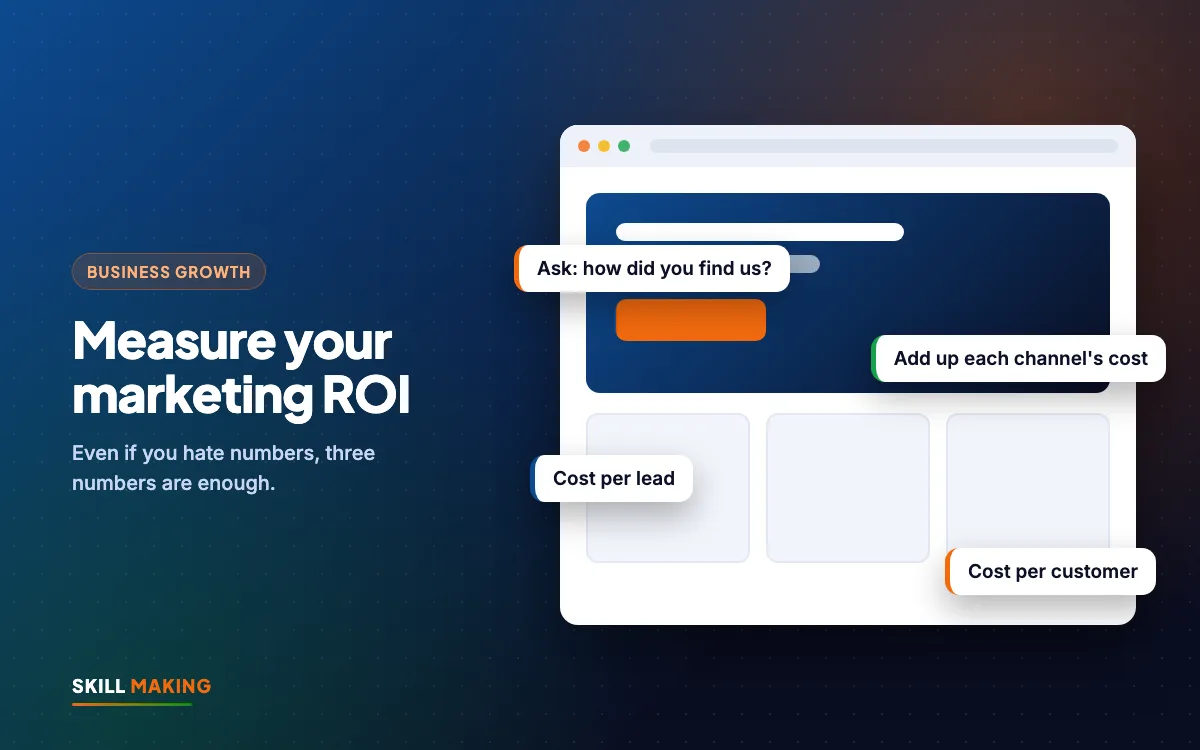
You cannot measure marketing ROI without knowing the source of each customer. This is the most important habit in this whole guide.
- Ask every new enquiry: "How did you hear about us?" Write the answer down.
- Use one list for all enquiries. A notebook, spreadsheet or simple CRM with date, name, source, what they wanted and whether they became a customer.
- Use different contact points where you can. For example, a separate WhatsApp link or phone number for ads, or a form that records the source.
- Use the free reports you already have. Google Business Profile shows calls and direction requests. Meta and Google Ads show clicks and leads. Google Analytics shows website visitors and form submissions.
- Check monthly, not daily. Daily numbers jump around. Monthly totals show real patterns.
Websites built on our Business package include lead tracking for calls, WhatsApp clicks and form submissions, which makes this much easier. See all packages.
Step 2: Add Up What Each Channel Costs
List everything you spend on marketing in a month. Include money and, if you can, time.
- Ad spend: Google Ads, Facebook and Instagram ads
- Agency or freelancer fees: SEO, ads management, social media
- Website costs: Spread the one-time price over a year or two, plus yearly hosting and domain (in India, usually about ₹2,500 to ₹6,000 a year)
- Printing and offline: Flyers, banners, newspaper inserts
- Tools: Paid apps or software
- Your time: Even a rough number helps. Five hours a week on Instagram is real cost.
Step 3: Calculate Three Simple Numbers
You only need three numbers to make most decisions.
Cost Per Lead
Total cost of a channel divided by number of enquiries it brought.
If you spent ₹6,000 on Facebook ads and got 30 enquiries, each lead cost ₹200. Our detailed guide on cost per lead explains what is good and bad.
Conversion Rate
Number of customers divided by number of enquiries.
If 30 enquiries turned into 6 customers, your conversion rate is 6 out of 30, or 1 in 5. This shows how well your follow-up and sales work, not just the marketing.
Cost Per Customer
Total cost of a channel divided by number of customers it brought.
₹6,000 divided by 6 customers means each customer cost ₹1,000. Now compare that with profit per customer. If each customer brings ₹4,000 profit, this channel is clearly worth it.
A Worked Example: Comparing Two Channels
Imagine a coaching institute running two kinds of marketing in one month.
- Google Ads: ₹8,000 spent, 20 enquiries, 5 admissions
- Boosted Instagram posts: ₹8,000 spent, 50 enquiries, 2 admissions
At first glance, Instagram looks better because it brought more enquiries. But look at cost per customer:
- Google Ads: ₹8,000 divided by 5 = ₹1,600 per admission
- Instagram: ₹8,000 divided by 2 = ₹4,000 per admission
If each admission brings ₹10,000 profit over the year, both are profitable, but Google Ads is much more efficient. The right decision might be to move more budget to Google Ads and improve the Instagram offer, not stop it completely. These numbers are only an example, and your results will be different, but the method is the same.
Read Google Ads vs Facebook Ads for more on how the two channels behave differently.
Use Lifetime Value, Not Just the First Sale
Many customers come back. A dental patient may return every year. A restaurant guest may visit monthly. A school family stays for years.
If you only count the first purchase, you may stop marketing that is actually very profitable. Make a rough estimate of what an average customer is worth over a year or two, and use that when deciding.
This is especially important for websites and SEO, which keep bringing customers month after month for a one-time investment. Try the calculator below to see how few extra customers a website needs to pay for itself:
pays for the whole website
After that, every customer the website brings is extra income — month after month.
One-time website price; domain and hosting are about ₹2,500–₹6,000 a year extra.
Measuring Things That Are Hard to Track
Some marketing does not lead directly to a trackable enquiry, but it still helps.
- Reviews make people trust you, which improves conversion from every other channel
- Social media reminds people you exist and shows proof of your work
- A website makes ads, Google profile visits and referrals more likely to turn into calls
- SEO builds slowly but can bring steady enquiries without paying per click. See how long SEO takes
For these, look at overall trends: are total enquiries growing, is conversion improving, are more people mentioning Google or your website when you ask how they found you?
If you would like help setting up tracking and making sense of your numbers:
Simple Tools for Tracking
- Paper notebook or spreadsheet: Enough for most small businesses to start
- WhatsApp Business labels: Tag enquiries by source, such as "Google", "Insta ad", "Referral"
- Google Business Profile insights: Calls, website clicks and direction requests
- Google Analytics and Search Console: Website visitors, searches you appear for, and forms submitted. Our SEO service sets these up properly
- Ads dashboards: Google Ads and Meta show cost and leads. Our Google Ads and Facebook ads teams report these in plain language
- A simple CRM: Useful once you have many leads or a team. Our AI automation service can connect forms, ads and WhatsApp into one place
Mistakes When You Measure Marketing ROI
- Counting likes, followers or clicks instead of enquiries and customers
- Using sales instead of profit in your calculations
- Judging a channel after one week instead of a full month or more
- Ignoring repeat customers and lifetime value
- Blaming marketing for leads that were lost through slow follow-up. Read why most leads go cold
- Never asking customers how they found you
A 30-Minute Monthly ROI Review
- Count enquiries by source for the month.
- Count customers by source.
- Add up the cost of each channel.
- Calculate cost per lead and cost per customer.
- Compare cost per customer with profit per customer.
- Decide for each channel: keep, improve or stop.
- Write down one change to try next month.
Do this every month for three months and you will understand your marketing better than most businesses your size. Our 90-day digital marketing plan fits well alongside this review.
What to Do Next
Start this week by asking every new customer how they heard about you, and keep a simple list. At the end of the month, run the 30-minute review above. That single habit is the easiest way to measure marketing ROI and stop wasting money.
Want help making sense of your current marketing? Ask for a free audit, and we will look at what you spend and what it brings. If you need a website with built-in lead tracking, request a free website plan. For Florida businesses, websites start from $300; see our Miami page for a cost calculator.