When you choose a website designer, you are not just buying a design. You are choosing someone who will decide how customers see your business online, who controls your domain, and whether your site actually brings enquiries. Get it right and the website quietly works for you for years. Get it wrong and you may be stuck with a slow site, no logins and a designer who stopped answering calls.
We have rebuilt many websites for owners who had a bad first experience. Most of those problems could have been avoided with a few questions before paying. Here are the 12 we would ask if we were in your place, including the answers you should hope to hear.
Before you choose a website designer, know what you want
You will get better quotes and fewer surprises if you are clear on a few things first:
- Your goal. More calls? More WhatsApp enquiries? Online orders? School admissions?
- Your budget range. Even a rough range helps a designer suggest the right option.
- Your pages. Use our checklist of pages every small business website needs to make a quick list.
- Your content. Do you have photos, service details and prices ready, or do you need the designer to write it?
- Your timeline. Is there a season, opening date or admission period you need to be live for?
Write these on one page and share the same page with every designer you talk to. That way you can compare like with like.
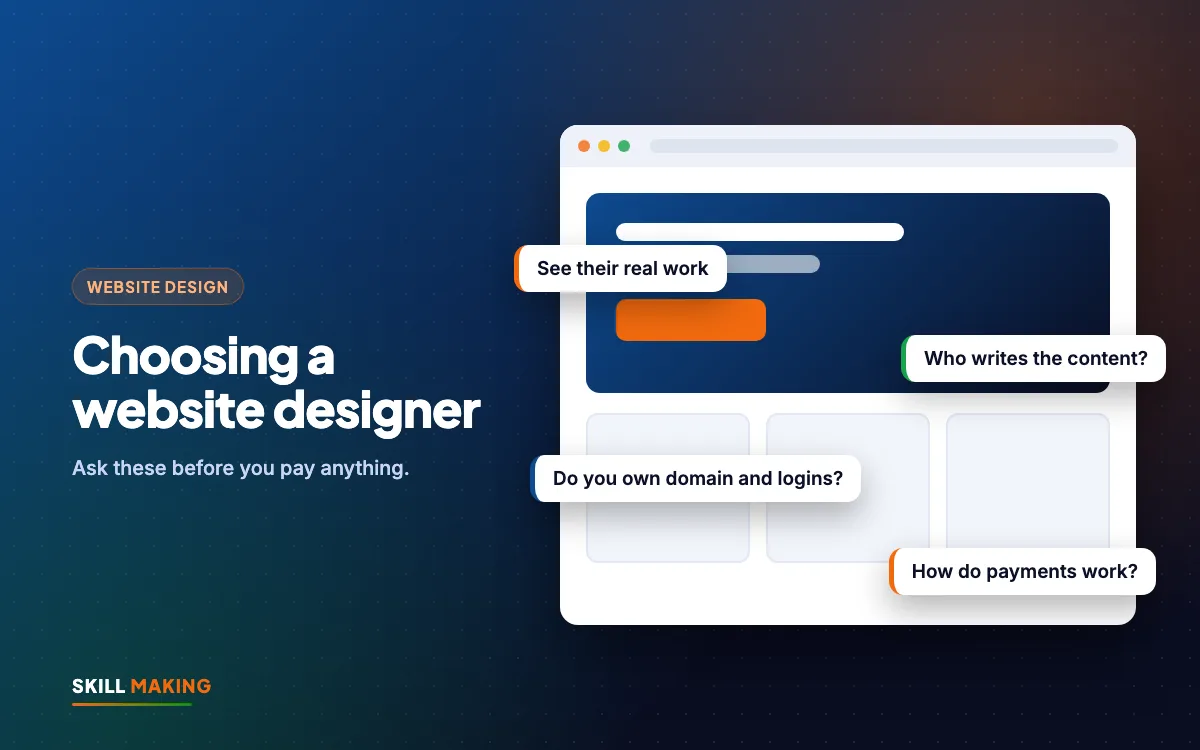
Question 1: Can I see websites you have built for businesses like mine?
A good designer will happily show live websites, not just screenshots. Open them on your phone. Check if they load quickly, look good and make contact easy.
Good answer: "Here are three live sites. One is a clinic, one a contractor, one a coaching centre." You can see our own projects on our work page.
Red flag: Only showing templates, mock-ups or sites that no longer work.
Question 2: Who will own the domain, hosting and logins?
This is the most important question on the list. Your domain name is your address on the internet. If someone else owns it, they effectively own your online presence.
Good answer: "The domain and hosting are bought in your name. You get every login."
Red flag: "We will register it under our account, do not worry about it." Many owners only discover the problem when they try to move to another designer.
Question 3: What exactly is included in the price?
Two quotes for "a website" can mean completely different things. Ask for a written list.
Check whether the price includes:
- Number of pages
- Content writing
- Mobile-first design
- WhatsApp, call buttons and enquiry form
- Basic SEO setup and Google Search Console
- SSL certificate
- Google Business Profile setup
- Support period after launch
At Skill Making, for example, our packages list every item clearly on the packages section.
Question 4: What will I pay every year after launch?
The one-time design price is only part of the cost. Ask about yearly costs upfront.
Typical yearly costs:
- Domain renewal
- Hosting
- Any paid plugins, themes or apps
- Optional maintenance plan
In India, domain and hosting for a small business site often cost roughly ₹2,500 to ₹6,000 a year. Be cautious of a very cheap design price paired with very high yearly "maintenance" that you cannot cancel.
Question 5: Who writes the content?
Many projects get stuck for weeks because the owner is waiting to write text. Find out early who is responsible.
Good answer: "We write it after a short call with you. You review and approve."
Red flag: "Send us everything and we will paste it in." That usually means a slow project and weak text.
Question 6: Will the site be built mobile-first and load fast?
Most of your customers will see your site on a phone. Ask how they make sure it works well there.
Good answer: They mention compressing images, testing on real phones and checking speed with tools like Google PageSpeed Insights. Read more about why this matters in mobile-first website design.
Red flag: "It is responsive, all themes are responsive now." That alone does not guarantee a good phone experience.
Question 7: What SEO is included, and what is not?
Every website needs basic SEO to be found on Google. But "SEO included" can mean anything from a real setup to nothing at all.
Ask whether they will:
- Write a unique title and description for each page
- Use clear headings with your services and town
- Submit a sitemap to Google Search Console
- Set up or improve your Google Business Profile
- Make the site fast and mobile-friendly
Red flag: Any promise of "number one on Google" or guaranteed rankings. Nobody can honestly promise that. Real SEO takes time; our post on how long SEO takes explains why.
Question 8: How long will it take, and what do you need from me?
Ask for a clear timeline and a list of what they need from you. A standard small-business website can often be ready in about two weeks if both sides are organised. Online stores take longer.
Good answer: "About 14 days. We need your logo, photos, service list and a 30-minute call."
Red flag: No timeline at all, or a timeline that keeps changing without reason.
Question 9: How do payments work?
A fair payment structure protects both sides.
Good answer: Part upfront, the rest after you approve the finished site. At Skill Making we take 50% to start and 50% after you approve.
Red flag: 100% upfront before any work is shown, especially from someone you have never worked with.
Question 10: How many revisions are included?
Ask how changes are handled during the project and after launch.
- How many rounds of changes are included?
- What counts as a "small change" versus extra work?
- How quickly do they respond to change requests?
Clear answers here prevent arguments later.
Question 11: What happens after launch?
A website is not a one-time event. Things will need updating: prices, photos, timings, offers.
Ask:
- Is there free support for a period after launch?
- Can I update simple things myself? Will you show me how?
- Is there an optional monthly maintenance plan, and what does it cost?
- Who do I call if the site goes down?
Question 12: Can you help bring visitors, not just build the site?
A beautiful site with no visitors does nothing. Ask whether they can help with the next steps, or at least advise you.
Useful extras include:
- SEO to be found on Google over time
- Google Ads for quicker enquiries
- Social media and Meta ads
- WhatsApp follow-up and simple automation
You do not have to buy these from the same designer, but it helps when the person building your site understands how customers will arrive.
Here is the journey a well-built site supports, from search to customer:
- Searches on Google“best clinic in your town”
- Opens your websiteFast and clear on mobile
- Sees photos & reviewsTrusts you in seconds
- Taps WhatsApp or CallThe enquiry reaches you instantly
- Visits and buysAnd comes back again
Red flags when you choose a website designer
If you hear any of these, think twice:
- "We will keep the domain in our name."
- "We guarantee first page on Google."
- "Pay the full amount now and we will start."
- No live examples of past work
- No written list of what is included
- No clear answer about yearly costs
- Very slow replies before you have even paid
How to compare quotes fairly
Quotes can look very different. Here is a simple way to compare them:
- Put every quote in a table with the same rows: pages, content writing, SEO, mobile-first, WhatsApp, form, Google Business Profile, support, timeline, yearly costs.
- Mark each item as included, extra cost, or not offered.
- Add up the total cost for the first year and for three years, not just the design price.
- Check live examples from each designer on your phone.
- Notice how each one communicated. Clear, quick, honest replies now usually mean the same later.
The cheapest quote is not always the best value. Neither is the most expensive. Look for the one that clearly includes what you need, at a fair price, from someone you trust. For typical price ranges in India, see our guide on website design cost in India.
If you want a quote you can compare against others, we will send a clear one:
Freelancer, agency or DIY builder?
Each option suits different situations:
- DIY website builders can work if you have time and a simple need, but many owners end up with a slow or unclear site and little help with Google.
- Freelancers can be affordable and personal. Check they will still be available for support months later.
- Agencies usually cost more than a freelancer but can handle design, content, SEO and ads together, with a team that does not disappear if one person is busy.
Whichever route you take, ask the same 12 questions before you choose a website designer or a platform.
What to do next
Save this list for the day you choose a website designer, and use it in your next conversation with any designer, including us. A good designer will be glad you asked, because clear questions lead to a smoother project.
Skill Making has built websites for more than 100 happy clients in India, the UK and the USA. Our India packages start at ₹14,999, and in the USA websites start from $300 (see our Miami website design page for a cost calculator). Get a free website plan and we will answer all 12 questions in writing.