
A few years ago, searching meant typing a question into Google and clicking a link. Today, many searches show an AI-written summary at the top, and many people ask chat assistants like ChatGPT, Gemini or Perplexity directly. Business owners are understandably worried: if the AI answers the question, will anyone still visit my website?
This guide looks at SEO and AI answers from a small business point of view. Not from a tech conference stage, but from the counter of a hardware shop in Haldwani or the office of a roofing company in Tampa.
The short version: the basics of good SEO matter more than ever, a few new habits help, and local businesses are in a better position than many people fear.
What "AI answers" actually means
There are two main places customers now meet AI answers.
- AI summaries inside Google. For some searches, Google shows an AI Overview at the top: a short written answer with links to the sources it used. Below it, the normal results and the map pack still appear.
- Chat assistants. People ask a tool like ChatGPT or Gemini, "Which is a good dentist in Dehradun?" or "How do I stop water seeping through my roof?" The assistant writes an answer, sometimes with links or business names.
Both use information already on the internet: websites, business profiles, reviews, directories and articles. That is the key point. AI answers are built from the same material SEO has always worked with.
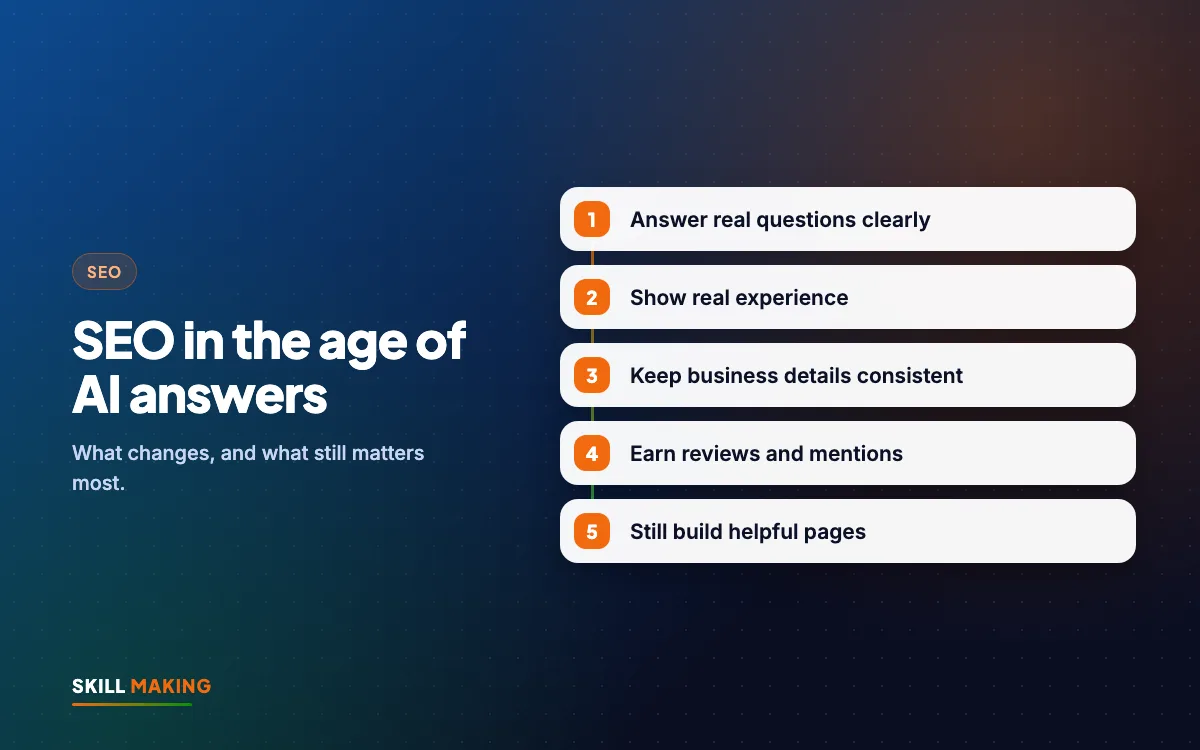
What SEO and AI answers change for small businesses
Some things really are different now.
- Simple information questions get answered on the spot. A question like "how many coats of paint for a new wall" may be answered by the AI summary, so fewer people click through to a blog post that only answers that.
- Being a trusted source matters more. AI tools tend to pull from pages that are clear, specific and consistent with other sources.
- Your business details must match everywhere. If your phone number on your website, Google profile and directories disagree, both people and machines get confused.
- Questions are getting longer. People type or speak full questions: "who is the best electrician near Kichha for an inverter installation". Pages that answer real questions in plain words fit these searches well.
What does not change
Plenty stays the same, and this is good news.
- People still hire local businesses they trust. An AI can explain how a geyser works. It cannot fix one at your house tomorrow morning.
- Ready-to-buy searches still lead to action. Searches like "AC repair near me" usually show the map pack, phone numbers and websites, because the person wants to call someone.
- Your Google Business Profile still matters a lot for "near me" and local searches.
- Reviews still build trust. Both people and AI summaries often reflect what customers say about you.
- A fast, clear website still converts visitors into calls and WhatsApp messages.
Here is the customer journey that still drives most local enquiries, AI or not:
- Searches on Google“best clinic in your town”
- Opens your websiteFast and clear on mobile
- Sees photos & reviewsTrusts you in seconds
- Taps WhatsApp or CallThe enquiry reaches you instantly
- Visits and buysAnd comes back again
SEO and AI answers: the new priorities
Think of your online presence as a set of facts and proof that any system, human or machine, can read and trust. These are the priorities that help with both SEO and AI answers.
1. Be crystal clear about who you are
- One consistent business name, address, phone and website everywhere.
- A clear "About" page: who runs the business, since when, what you specialise in and where you work.
- Service pages that say exactly what you do and do not do.
2. Answer real questions directly
- Put the most common customer questions on your service pages as a short FAQ.
- Start each answer with a direct one or two sentence reply, then add detail.
- Use the words customers use, including Hindi or Hinglish where relevant.
3. Show proof that only you have
AI can rewrite general advice. It cannot invent your real work.
- Project photos with the location and type of work.
- Short case stories: the problem, what you did, and how the customer felt.
- Your own prices or price ranges, if you are comfortable sharing them.
- Your opinions and experience: "in our area, we usually recommend this because of the heavy monsoon".
4. Build reviews and mentions
- Ask every happy customer for a Google review. Our guide on how to get more Google reviews has ready-made messages.
- Get listed on trusted local directories and industry associations.
- Ask suppliers, partners or local news sites to mention your business when it makes sense.
5. Keep the technical basics clean
- Fast, mobile-friendly pages.
- Clear headings and page titles. Our on-page SEO checklist covers these.
- Structured data (schema) for your business details and FAQs, so machines can read facts easily.
- Make sure important pages are indexed in Google Search Console.
A step-by-step plan to prepare your business
If you only have a few hours a month, follow this order.
- Search for your own business on Google and in one or two chat assistants. Ask "what do you know about [your business name] in [your town]". Note anything wrong or missing.
- Fix your Google Business Profile. Correct name, categories, hours, photos, services and description. Our Google Business Profile guide walks you through it.
- Fix inconsistent details on directories, social media and your website.
- Improve your top three service pages with clear descriptions, FAQs, real photos and a simple call to action.
- Start a review habit so new reviews arrive every month.
- Publish one genuinely helpful article a month based on a question customers actually asked you, with your local experience added.
- Check again every few months and see how the answers about your business have changed.
Should you still write blog posts?
Yes, but write differently.
Generic posts like "10 benefits of painting your house" are exactly the kind of content AI summaries can replace. Posts that still earn their place are:
- Local and specific: "Best time to waterproof your roof before the monsoon in Uttarakhand".
- Based on your experience: "Why we stopped using cheap PVC pipes in our projects".
- Decision helpers: comparisons, cost guides and checklists, with your honest view.
- Linked to a service: every post should point to the service page that solves the problem.
If writing is not your thing, our SEO service includes content written from your real expertise, not filler.
How small businesses compare with big brands now
Here is how a small business can stand next to bigger players when AI answers are part of search:
Store locators with address, map and timings for every outlet
Brands like Domino’s and TanishqA page for your town + Google Business Profile with map and timings
Click-to-call and chat on their pages
Brands like TanishqWhatsApp and call buttons on every screen
Doctor profiles and online appointment requests
Brands like Apollo HospitalsAn enquiry or booking form that lands on your WhatsApp
Ratings and reviews right where people decide
Brands like AmazonYour best Google reviews shown on your website
Brand names belong to their owners and are used only as examples of common website features. Skill Making is not connected with them.
Big brands have bigger budgets, but local businesses have local proof, personal service and real customer stories in their own town. Those are exactly the things that help people and AI tools trust a local recommendation.
Mistakes to avoid
- Mass-producing AI-written articles. Pages full of generic text add little value and can make your site look less trustworthy. Use AI as a helper, but add your own knowledge and check every fact.
- Ignoring your Google profile because you think "AI will replace Google". Local results are still a key way customers find you.
- Hiding prices, areas and contact details. Vague pages are hard for anyone to recommend.
- Panicking and rebuilding everything. Most of what worked before still works. Improve, do not throw away.
- Believing anyone who promises to "rank you in ChatGPT". Nobody controls what AI tools say. You can only make your business clear, credible and well-reviewed.
Using AI in your own marketing
AI is not only something that affects your search traffic. You can use it too, carefully.
- Draft FAQs from customer questions, then edit them in your own voice.
- Summarise customer reviews to find common praise and complaints.
- Draft replies to reviews and WhatsApp enquiries, then personalise them.
- Automate simple follow-ups so no lead is forgotten. Our AI and automation service helps small businesses set this up.
For more ideas, read how small businesses can use AI without losing the human touch.
Want to know how your business currently looks to Google and AI tools? Let us check it for you:
What to do next
The rise of SEO and AI answers does not mean SEO is over. It means clarity, consistency, proof and reviews matter more than clever tricks. Local businesses that keep their details accurate, answer real questions and show real work are well placed.
Start by searching your own business today and noting what is wrong or missing. Then ask us for a free audit, and we will review your website, Google profile and online mentions and give you a clear, honest plan. If your website itself needs an upgrade, see our website packages.