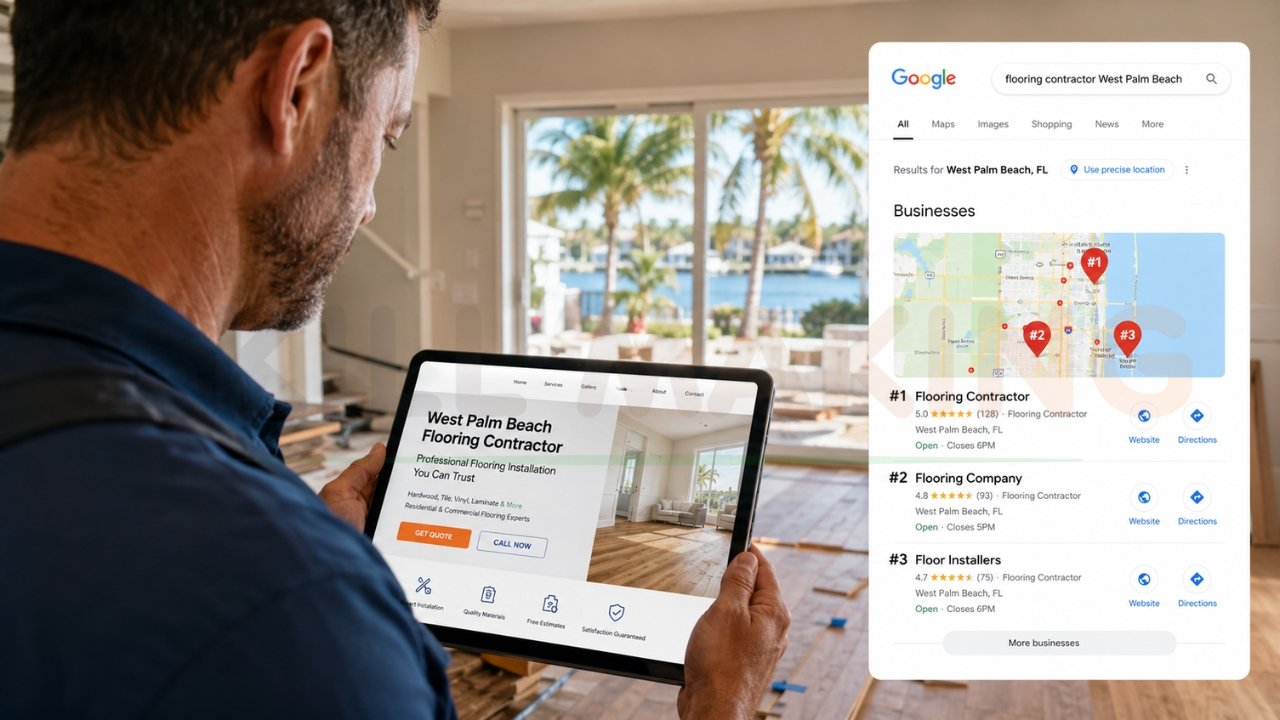
In the high-speed digital economy of 2026, the bridge between a potential customer and your business is your website. Research from the Nielsen Norman Group indicates that users judge a company’s credibility within milliseconds of landing on their page. Approximately 75% of users base their entire opinion of a business’s reliability on its website design alone. If your site is difficult to navigate or looks outdated on a mobile screen, you aren’t just losing a visitor; you are handing a high-value contract to a competitor who invested in a professional digital presence.
The importance of web design in digital marketing strategy has transcended mere aesthetics. Today, your website is your 24/7 sales representative, your brand’s technical authority, and the primary engine for lead generation. In modern markets—especially high-growth sectors like Florida’s construction and trade industries—over 60% to 80% of all web traffic originates from mobile devices. Without a conversion-focused, responsive design, even the most expensive marketing campaigns will fail to deliver a positive ROI.
Let Skillmaking create a high-performing web design for your digital marketing strategy and turn your traffic into tangible growth.
What Is the Role of Web Design in Digital Marketing Strategy?
Web design is the structural foundation upon which all other digital marketing efforts are built. It is not an isolated component; rather, it is the central hub that connects SEO, social media, paid advertising, and email marketing.
The role of web design in digital marketing is to act as the ultimate “closer.” While your social media ads might attract attention and your SEO efforts bring in traffic, it is the website’s design that convinces the visitor to take action. This involves a seamless blend of:
- Information Architecture: Organizing content so users and search engine bots can find what they need instantly.
- Visual Storytelling: Using high-resolution galleries and consistent branding to build immediate trust.
- Functional Reliability: Ensuring forms work, buttons are clickable, and pages load in under 2 seconds—the “2-second rule” for retaining high-intent leads.
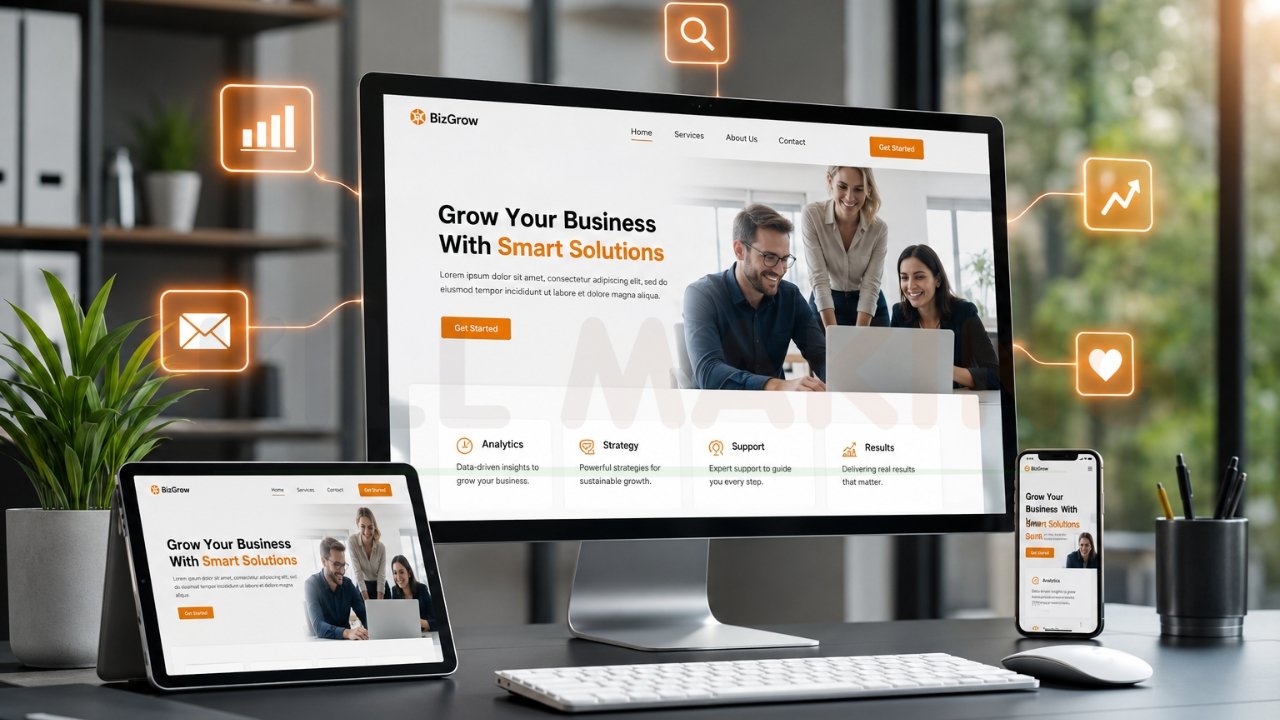
Why Web Design Is Critical to the Success of Your Digital Marketing?
Imagine spending thousands on Google Ads for your remodeling business. A homeowner in Miami clicks your ad while on their phone, but your site takes 5 seconds to load or has tiny buttons they can’t click. They “bounce” immediately, and your ad budget is wasted.
This illustrates how web design affects marketing results. A poorly designed site acts as a leak in your sales funnel. Conversely, a professional site built with a mobile-first design ensures that the version of your site Google uses for indexing is the one that ranks highest and converts best. As we move through 2026, digital invisibility or a poor user experience (UX) is no longer just a minor issue; it is a significant business liability that can lead to a loss of potential leads to tech-savvy competitors.
10 Key Reasons Showing the Importance of Web Design in Digital Marketing Strategy
- First Impressions and Trust: Users judge your professionalism within milliseconds. If your site looks “cheap,” they assume your service is too.
- SEO Ranking Boost: Google uses mobile-first indexing; sites optimized for mobile see a 20–30% improvement in search rankings.
- Consistent Brand Identity: Design ensures your brand message remains uniform across all digital channels, building long-term authority.
- Optimized User Experience (UX): A site that is easy to navigate keeps users on the page longer, signaling to search engines that your content is valuable.
- Higher Conversion Rates: A conversion-focused web design removes friction, using “sticky” call buttons and optimized forms to increase inquiries by 20–30%.
- Mobile Accessibility: With 70-80% of searches happening on phones, a responsive site is essential for survival in local service markets.
- Speed and Performance: Fast-loading sites prevent “bounce” and are a critical factor in Google’s ranking algorithms.
- Reduced Bounce Rates: When users find what they need instantly, they stay. High bounce rates tank your SEO and waste your PPC budget.
- Technical Authority: Displaying licenses, certifications, and safety awards through professional design builds instant credibility.
- Competitive Advantage: Many small businesses still use outdated templates. A custom, high-performing site sets you apart as a market leader.
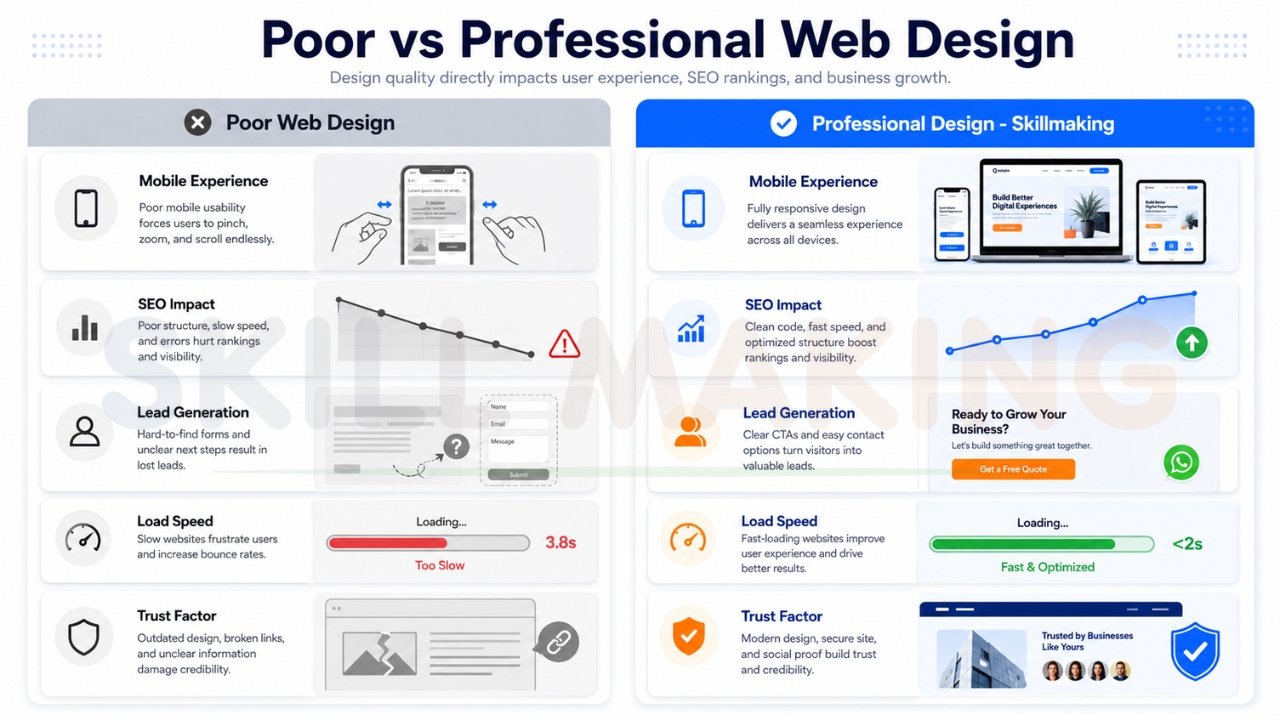
Comparison: Poor vs. Professional Web Design
| Feature | Poor Web Design | Professional Design (Skillmaking) |
|---|---|---|
| Mobile Experience | “Pinch-and-zoom” required. | Fluid, responsive, and intuitive. |
| SEO Impact | Penalized by Google. | Boosted by mobile-first indexing. |
| Lead Generation | Hidden contact info; high friction. | “Sticky” CTAs and instant WhatsApp. |
| Load Speed | Over 3 seconds (High bounce). | Under 2 seconds (High retention). |
| Trust Factor | Looks disorganized or closed. | Builds instant digital credibility. |
Get a conversion-focused website designed by Skillmaking today and stop losing leads to a “short circuit” in your design.
👉 Want More Leads, Sales & Customers from Your Website? 📞 WhatsApp Today: +91 7906334941
How Great Web Design Improves SEO, User Experience & Conversions?
The synergy between web design and SEO is undeniable. According to the Moz Beginner’s Guide to SEO, search engines must first be able to crawl and read a site before any ranking factors can apply. A professional design uses a clean codebase, proper sitemaps, and canonical tags to make this process seamless.
Furthermore, best web design for digital marketing prioritizes the user journey. By integrating the technical pillars of responsive design—fluid grids, flexible images, and media queries—you ensure a consistent experience across all devices. When a user in Tampa finds your plumbing site after an emergency search, a “Call Now” button that is front and center on their smartphone can be the difference between a booked job and a missed opportunity.
The Connection Between Web Design and Major Marketing Channels
Your website design doesn’t just sit in a vacuum; it directly impacts every channel you use:
- SEO (Search Engine Optimization): Technical design elements like site speed, mobile-friendliness, and structured data are foundational “Mozlow’s” needs for ranking.
- Social Media: When you share project galleries on Instagram or LinkedIn, the “landing page” must be just as visually impressive to maintain trust.
- PPC (Pay-Per-Click): Google Ads gives higher “Quality Scores” to sites with relevant, fast-loading landing pages, lowering your cost-per-click.
- Email Marketing: Nurture sequences are only effective if they lead the user back to a site where they can easily complete a “Request a Quote” form.
- Content Marketing: Educational blogs and guides need a clean, readable layout to establish your long-term authority in your niche.
Special Focus: Importance of Web Design for Construction & Home Improvement
For contractors, home builders, and trade specialists, the stakes in 2026 are exceptionally high. Florida’s $2.145 trillion construction market is fiercely competitive. Word-of-mouth is no longer enough; digital reputation is now as vital as physical craftsmanship.
- Visual Currency: In the flooring or remodeling industry, high-resolution “before and after” galleries are the ultimate proof of value.
- Emergency Service Capture: Plumbers and electricians get the majority of their leads from mobile “emergency” searches. If your site doesn’t load instantly on a 4G signal at a job site, that lead is gone.
- Local SEO Dominance: Appearing in the “Local Map Pack” depends on your site’s mobile-responsiveness and technical health.
Common Web Design Mistakes That Kill Digital Marketing Results
Many firms make critical errors that deter 70% of potential visitors. To ensure your strategy remains solid, you must avoid:
- Ignoring the Mobile Audience: In 2026, a site that isn’t mobile-friendly is effectively broken.
- Slow Loading Speeds: Large, unoptimized images cause high bounce rates. Professional optimization is required to maintain quality without sacrificing speed.
- Generic Templates: Using a “cookie-cutter” look makes a premium brand look small and untrustworthy.
- Lack of Clear Contact Info: If a client has to hunt for your phone number, they will go to a competitor.
To learn more about aligning your digital presence with your business goals, read our guide on avoiding common marketing mistakes construction companies make and understand exactly what marketing is in the construction industry today.
Must-Have Web Design Elements for a Strong Digital Marketing Strategy in 2026
To stay ahead, your website needs to integrate these modern essentials:
- Mobile-First Precision: Design for the smartphone user first, then scale up for desktop.
- Instant Communication Tools: WhatsApp buttons and “Call Now” features should be prominent.
- Hyper-Local SEO Content: Targeted pages for specific cities like Miami, Tampa, or Orlando.
- Social Proof Integration: Pulling verified Google reviews directly onto your home page to build immediate trust.
- SSL Security and Compliance: Advanced security protocols to protect user data and meet Florida-specific regulations.
- Dynamic Project Galleries: Interactive sliders showing transformations and restorations.
If you’re struggling to find consistent work, check out our insights on how to get more home improvement leads through high-performing design.
How Skillmaking Builds Websites That Supercharge Digital Marketing Results?
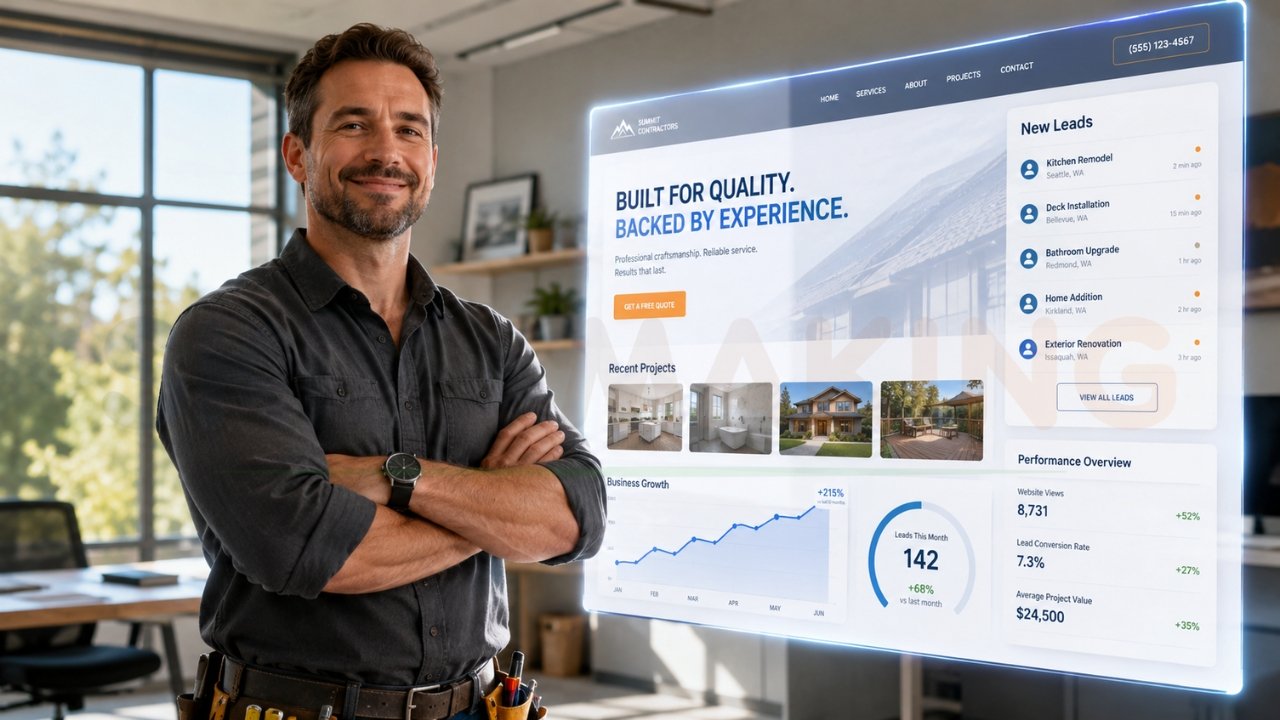
At Skillmaking, we don’t just build “pretty” websites; we build lead-generation machines. Our 5-step process ensures your digital storefront is open for business 24/7:
- Market & Region Analysis: We identify the “missing circuits” in your current strategy based on your specific service area in Florida or India.
- Frictionless UX Design: We ensure users are never more than one click away from calling you.
- Technical Development: Using lightning-fast frameworks for instant loading, even on weak cell signals.
- Conversion Optimization: Integrating WhatsApp, lead forms, and call tracking so you know your ROI.
- Performance Monitoring: Ongoing support to keep your site compliant with evolving search algorithms.
Our clients have seen an average 3.8x growth in organic traffic and over 300% increase in qualified leads within six months.
Frequently Asked Questions
- Does web design really affect my Google ranking?
Yes. Google uses mobile-first indexing, meaning the mobile version of your site is the primary version used for ranking. Sites with poor mobile experiences are penalized. - Is WordPress still the best choice for a business website in 2026?
For most small-to-mid-sized businesses, WordPress remains the top choice due to its flexibility, SEO capabilities, and ease of updates. - What is the “2-second rule” in web design?
It is the standard that a professional website should load in under 2 seconds. Any longer, and you risk a massive “bounce” from impatient mobile users. - How much should I budget for a professional contractor website?
In the Florida market, high-quality, lead-generating sites typically range from $5,000 to $10,000, depending on complexity and SEO needs. - Can I just use a DIY builder like Wix or Squarespace?
While cheap initially, DIY builders often lack the advanced Local SEO and speed optimization required to dominate a competitive market like Florida. - What is the difference between responsive and adaptive design?
Responsive design is a single site that fluidly changes for all screens. Adaptive design uses fixed layouts for specific devices. Responsive is the industry standard recommended by Google. - How often should I update my website design?
To keep up with changing technology and visual trends, a refresh is recommended every 2–3 years. - Why is “click-to-call” so important for trade businesses?
Because over 70% of local leads search on mobile. Making it easy for them to call you instantly can increase inquiries by 20–30%.
Conclusion: Take Control of Your Digital Future
In 2026, the businesses winning the most projects are not necessarily those with the best tools or the longest history—they are the ones with the best visibility. Your website is no longer a luxury; it is the foundation of your success. A professional web design for digital marketing ensures you are reachable, credible, and visible no matter where your customers are searching.
Don’t let another high-value inquiry go to a competitor just because your site was too slow or non-responsive. Stop losing jobs to “digital invisibility” and start building your lead-generation machine today.
Ready to dominate your local market?
Let Skillmaking create a high-performing web design for your digital marketing strategy.
- WhatsApp Us Now: +91-7906334941
- Visit Us: https://skillmaking.com
- Email: info@skillmaking.com
Contact Skillmaking today for a free design consultation and watch your business transform into a recognized industry leader.